

Zig Zagging Through Greenland
On scale, attention, and the quiet details that turn wonder into care

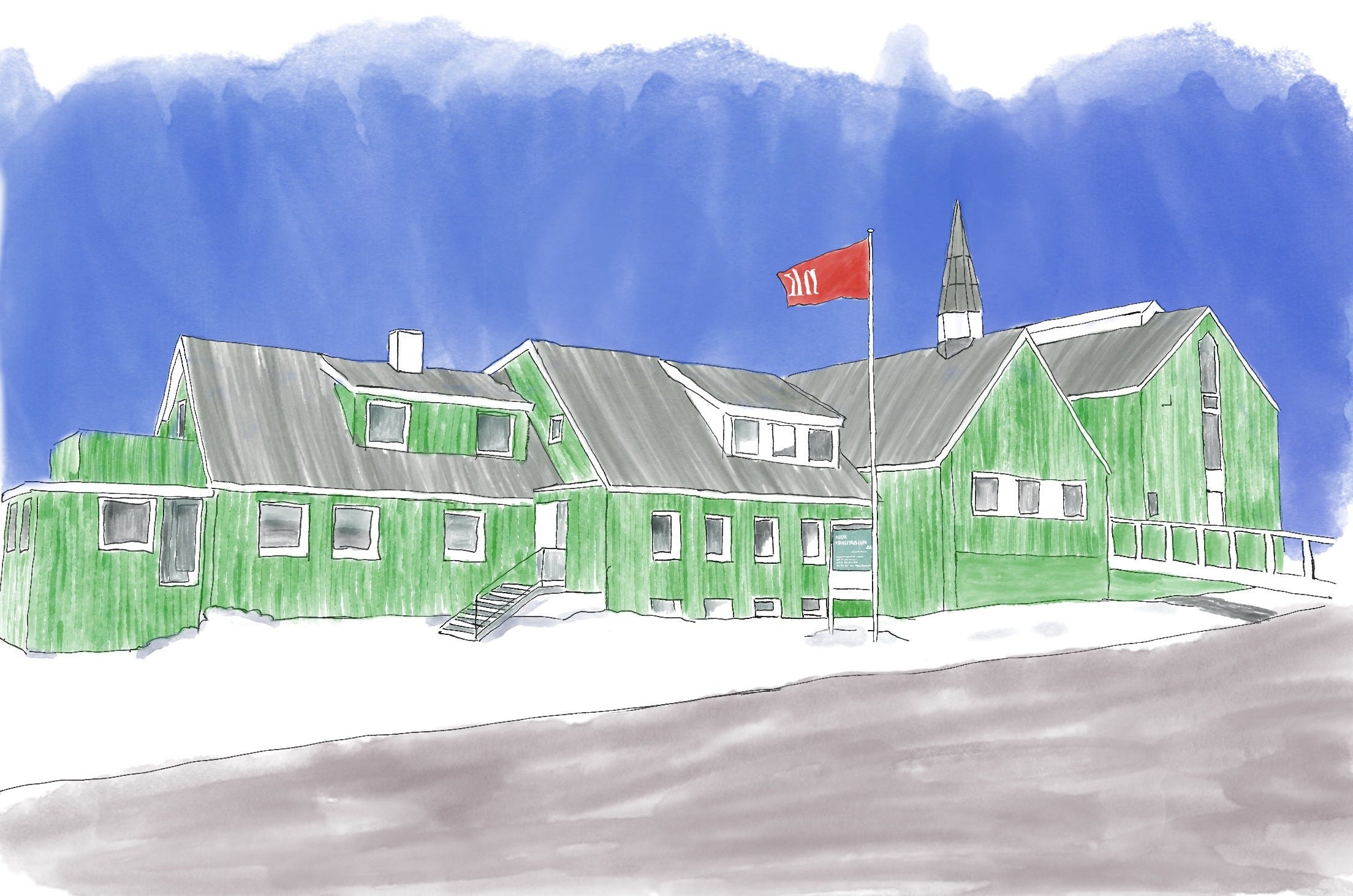
When I visited the Nuuk Kunstmuseum last spring, I was looking forward to spending a quiet hour with some local art and learning a little about Greenlandic artists. I didn’t anticipate the exhibition following me out the door and shaping the way I saw the rest of Greenland.
In any art museum, you expect to see artwork arranged in a particular order, the curator having prepared the collection with a certain choreography in mind. How you do that dance is a negotiation between the curator’s intentions and your focus.
And while each visitor’s interaction with the art is going to be different, it’s safe to say that more often than not, pieces in the exhibit have relatively equal footing.
But that wasn’t necessarily the case in the exhibition called Silarsuaq takuiuk // Micro-Macro. The collection of 42 works included some of the museum’s largest pieces and some of its smallest, and the juxtaposition of different sizes of artwork created a surprisingly visceral experience.
The large pieces1 demanded attention. You couldn’t not notice them. They oriented your body in the room before you even made a conscious choice to move. You noticed them first, and then intuitively stepped back to admire and take in the scale. These pieces asserted themselves through their size and presence, and they set the visual tone simply by existing at that magnitude.
The tiny pieces, on the other hand, sat quietly, waiting to be noticed. Miniature sculptures, small prints, and micro-watercolors2, did not announce themselves at all. They waited. To see them required intention: slowing down, moving closer, and for some of us donning our reading glasses. Their details were intricate and precise, entire worlds contained in mere centimeters, quietly hoping to be noticed, in danger of being invisible.
So there I was moving not just forward through the exhibit space, but alternating between stepping back from, and closer to, the art. The curator’s dance, it turns out, was a zig zag.
A plaque on the wall noted that the exhibition took its name from a 1985 song, Silarsuaq takuiuk3 by Greenlandic band Zikaza, described as an invitation to recognize the wonder of the world through immersion, and to care for it once you do. I took note of band and song title, to find and listen to later, without realizing how closely it mirrored the experience unfolding around me not just in this exhibit, but throughout the rest of my trip.
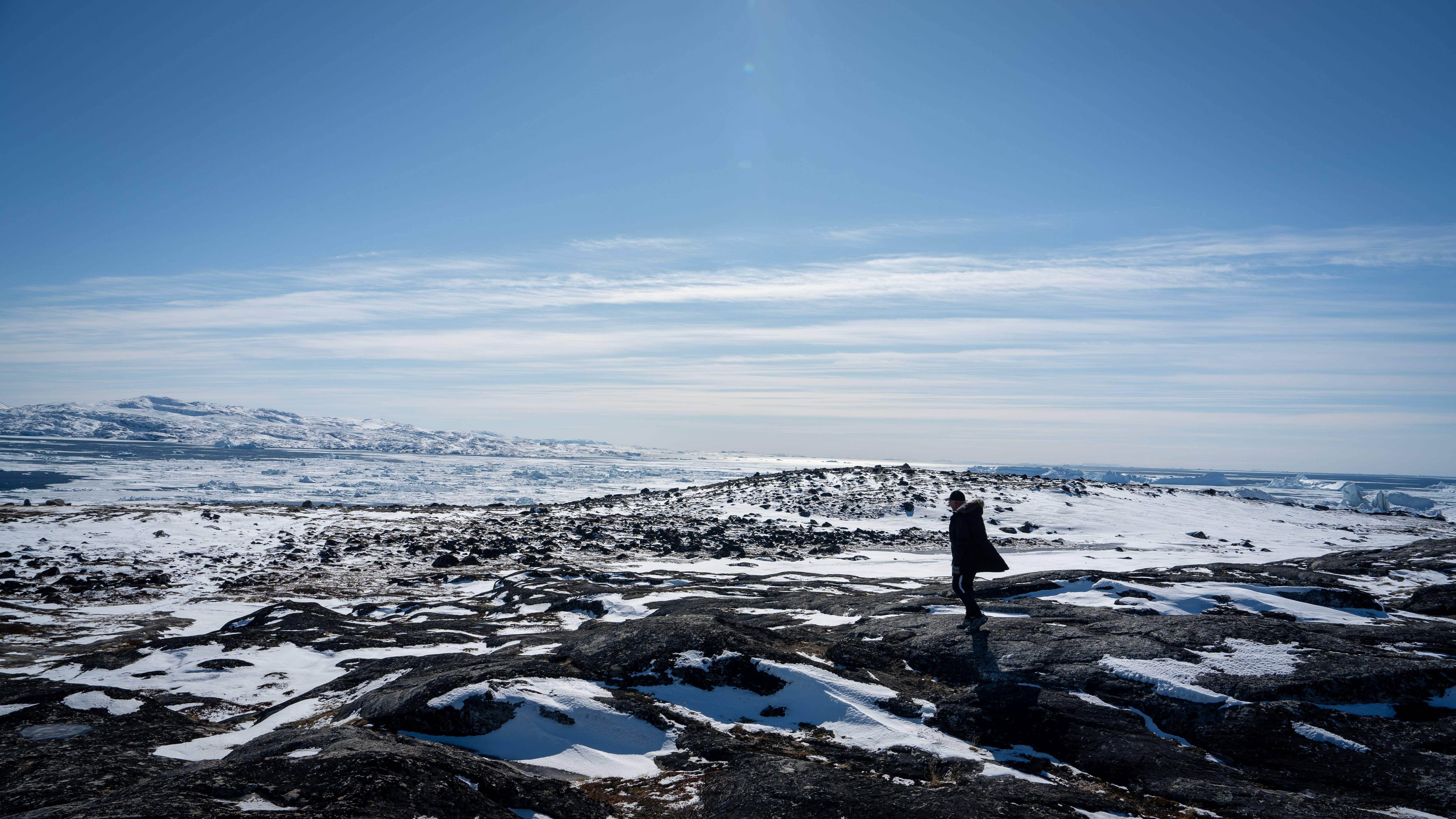
It’s tempting, in a place as vast as Greenland is, to let scale stand in for understanding. Greenland lured me in with it large-scale vistas — icebergs the size of skyscrapers, endless horizons of ice and sky, even the map that stretches uninterrupted, with its towns clinging to the coasts and unconnected by roadway lines.
But the longer I stayed, the less satisfied I was with that reading. Things shifted when I stopped moving on and began to move in—when I treated the landscape less like a view and more like a space to enter. Small details began to register: textures at the harbor, colors embedded in the rock, the many kinds of ice held inside what first looked like a single form. Sounds, too—things I would have missed entirely if I hadn’t slowed down.
Snow isn’t just the white in the palette; it’s surface and structure, shaped by wind and temperature. Paths across the ground record patterns of movement—human, animal, environmental. Settlements that look small against the land, on closer inspection, are actually precise, deliberate responses to it.
Greenland is vast, but it isn’t empty.
I started to wonder how often I mistake scale for comprehension.
Size, after all, has a way of determining authority. The biggest views, the widest angles, the loudest voices often stand in for the whole. And in our fast-paced, social media-fueled lives, we tend to let them. I’m as guilty as the next person in letting the headlines inform, the Instagram photo represent, and the algorithm determine what’s important.
Giving in to those shortcuts, however, limits our ability to really see and understand. When we let them speak for a place—or for the people who live there—we don’t see what actually gives it form . What we miss isn’t just detail. It’s distinction.
Instagram is happy to stop at the big vistas. But travel, at least travel that changes you, that connects you to a place, and that “kills bigotry, prejudice, and narrow-mindedness4,” requires you to move closer. To adjust your position.
I didn’t hear the song the exhibition referenced until much later, but its idea had already taken hold. Immersion, it suggested, is what turns wonder into care. I recognized that shift happening in real time. The more I moved closer—away from the view and into the details—the harder it became to keep my relationship to Greenland abstract.
There’s nothing wrong with being drawn to the large-scale spectacle. Greenland is full of it, and it is stunning. But spectacle is only an introduction. If that’s where you stop, you miss something essential. Care doesn’t come from the widest view. It comes from the details that only appear when you’re willing to let your path do a little zig zag.
Such as Maria Paninnguaq Kjærulff’s Skovkalkuner (2004)
Such as those by Mike Lynge
“Travel is fatal to prejudice, bigotry, and narrow-mindedness, and many of our people need it sorely on these accounts. Broad, wholesome, charitable views of men and things cannot be acquired by vegetating in one little corner of the earth all one’s lifetime.” – Mark Twain, The Innocents Abroad